Building Real Strength: The Truth About Best At Home Resistance Equipment
You don't need a warehouse full of iron to build a physique that commands respect. However, you do need the right tools. The market is flooded with cheap gadgets promising six-pack abs in minutes, making it nearly impossible to distinguish between marketing fluff and the best at home resistance equipment.
If you want to stimulate hypertrophy (muscle growth) and strength gains outside of a commercial gym, you have to understand how to load the muscles effectively. Gravity alone often isn't enough. This guide cuts through the noise to focus on equipment that offers genuine progressive overload.
Key Takeaways: Quick Summary
- Adjustable Dumbbells: The gold standard for isolation and compound movements; saves space while offering heavy loads.
- Loop Resistance Bands: Essential for linear variable resistance (getting heavier as you stretch) and mobility work.
- Suspension Trainers (TRX/Rings): Best for bodyweight leverage and core stability.
- Kettlebells: Superior for ballistic movements and posterior chain development.
- Weighted Vests: The simplest way to overload calisthenics without changing your mechanics.
The Hierarchy of Home Resistance
When selecting the best at home training equipment, prioritize versatility and footprint. Unless you have a dedicated garage, you cannot afford single-use machines. We judge equipment based on its ability to provide progressive overload—the ability to make an exercise harder over time.
1. Adjustable Dumbbells: The Foundation
Fixed dumbbells are fantastic, but a full rack costs thousands and takes up an entire wall. Adjustable dumbbells are the logical solution for home gyms.
Look for a mechanism that feels secure. The science here is simple: mechanical tension. To grow, a muscle needs to be taken close to failure. Adjustable bells allow you to micro-load exercises, moving from 20lbs to 22.5lbs, which is critical for smaller muscle groups like shoulders and biceps.
2. Resistance Bands: Linear Variable Resistance
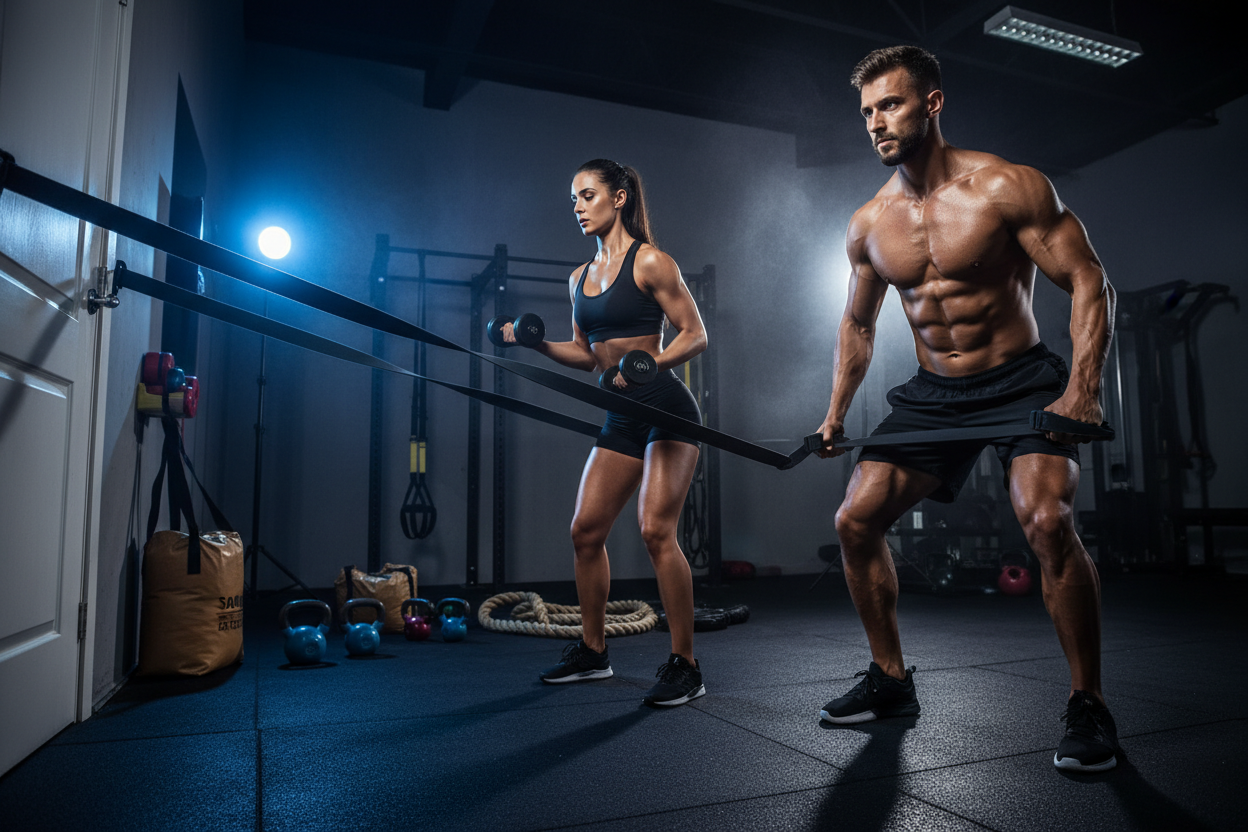
Many lifters scoff at bands, thinking they are just for warm-ups. They are wrong. Bands provide linear variable resistance. As you stretch the band, the resistance increases.
This matches the "strength curve" of many exercises. Think about a bench press: you are strongest at the top (lockout). A band is heaviest at the top. This forces your muscle to fire harder throughout the entire range of motion, rather than coasting at the easiest part of the lift.
3. Suspension Trainers: Mastering Leverage
If you want the best at home workout accessories that fit in a drawer, get a suspension trainer or gymnastic rings. These tools utilize your body weight but change the lever arm.
By adjusting your foot position by an inch, you can increase the load significantly. Furthermore, the instability forces your stabilizer muscles (like the rotator cuff and abs) to work overtime, leading to functional strength that transfers well to sports.
Common Mistakes When Buying Gear
Buying "All-in-One" Machines: Cheap Bowflex knock-offs often have friction issues and limited ranges of motion. Stick to free weights and bands where you control the path of movement.
Ignoring Grip Width: When looking for the best at home training equipment, check the handle diameter. Cheap dumbbells often have thin, plastic handles that become slippery with sweat. Look for knurled metal handles.
My Personal Experience with best at home resistance equipment
I want to be transparent about what this gear is actually like to live with. I spent two years training exclusively in a spare bedroom, and there is an unpolished reality that product descriptions hide.
Specifically regarding adjustable dumbbells: most reviews don't mention the "waddle." Because the frame has to accommodate the widest weight setting, doing exercises like bicep curls or goblet squats can be awkward. I distinctly remember the cold metal plates clanging against my hip bones every time I tried to bring the weights up for a shoulder press. It bruises.
Also, with heavy loop bands, the smell of latex sticks to your hands for hours, no matter how much you scrub. And that moment when a heavy band rolls up and pinches the hair on your legs during a squat? It hurts worse than the workout. These are the trade-offs for convenience, but once you adjust your mechanics to work around the bulky gear, the gains are absolutely real.
Conclusion
Building a home gym isn't about replicating a commercial fitness center; it's about efficiency. By investing in the best at home resistance equipment—specifically adjustable weights and high-quality bands—you remove the friction between you and your workout. Start with the basics, master the movements, and add accessories only when your strength demands it.
Frequently Asked Questions
What is the single best piece of equipment for small spaces?
If space is tight, a set of heavy-duty loop resistance bands is superior. They can replicate deadlifts, presses, and squats, and they can be stored in a shoebox. Combine this with a door anchor for maximum versatility.
Are water-filled weights effective?
Generally, no. While portable, the water sloshing creates instability that is often unpredictable and distracting for hypertrophy training. Solid iron or sand-filled equipment is more consistent for tracking strength gains.
Do I need a bench for home workouts?
While not strictly necessary, a sturdy adjustable bench significantly increases your exercise variety. It allows for chest support during rows (saving your lower back) and proper angles for pressing movements.