Assisted Chin-Up Dip Machine — Is It Worth the Home Gym Space?
Let's face it: mastering the strict pull-up or deep triceps dip is one of the most frustrating plateaus in strength training. If you are outfitting a garage gym or basement setup, you might be wondering how to bridge that gap safely without relying on snapping resistance bands. Enter the assisted chin-up dip machine. This guide will break down the footprint, mechanics, and value of this specialized equipment to help you decide if it deserves a spot in your home gym.
Key Takeaways
- Progressive Overload: Counterbalance weight stacks allow you to gradually decrease assistance as your natural strength improves.
- Vertical Space Requirements: These machines require significant overhead clearance, typically needing ceilings of at least 8 to 9 feet.
- Targeted Muscle Isolation: Perfect for strictly isolating the lats, biceps, chest, and triceps without momentum or swinging.
- Multi-User Friendly: An excellent investment for households with multiple users at vastly different fitness levels.
Space Planning: Will It Fit Your Home Gym?
Height Clearance and Footprint
The biggest hurdle for home gym owners in North America is ceiling height. Most standard basement ceilings sit around 8 feet (96 inches). A commercial-grade assisted chin up dip machine often stands between 82 and 89 inches tall. You must factor in your own head clearance when at the top of the pull-up movement. Always measure your ceiling height and subtract at least 12 to 15 inches to ensure you won't be bumping your head against the rafters.
Floor Support Considerations
Because these units house massive weight stacks (often 200+ lbs) plus the heavy-duty steel frame, the total weight can easily exceed 400 to 500 lbs before you even step on it. Ensure your home gym flooring—especially if located on a second story or over a crawlspace—can handle the static load. High-density rubber stall mats are highly recommended to protect your foundation.
Key Specs to Compare Before Buying
Weight Stack vs. Plate-Loaded
When shopping, you will encounter two main styles. Selectorized weight stack machines are the gold standard for convenience, allowing you to change resistance with a simple pin drop. However, they are expensive and incredibly heavy. Plate-loaded variations are far more budget-friendly and easier to move, utilizing your existing bumper or iron plates to create the counterbalance.
Build Quality and Upholstery
Look for 11-gauge steel frames for maximum stability. The knee pad is the most frequently used contact point, so high-density foam with double-stitched, sweat-resistant vinyl is crucial for longevity. Cheaper models often feature thin pads that compress over time, leading to bruised shins and knees.
Training Applications and Progression
Mastering Strict Form
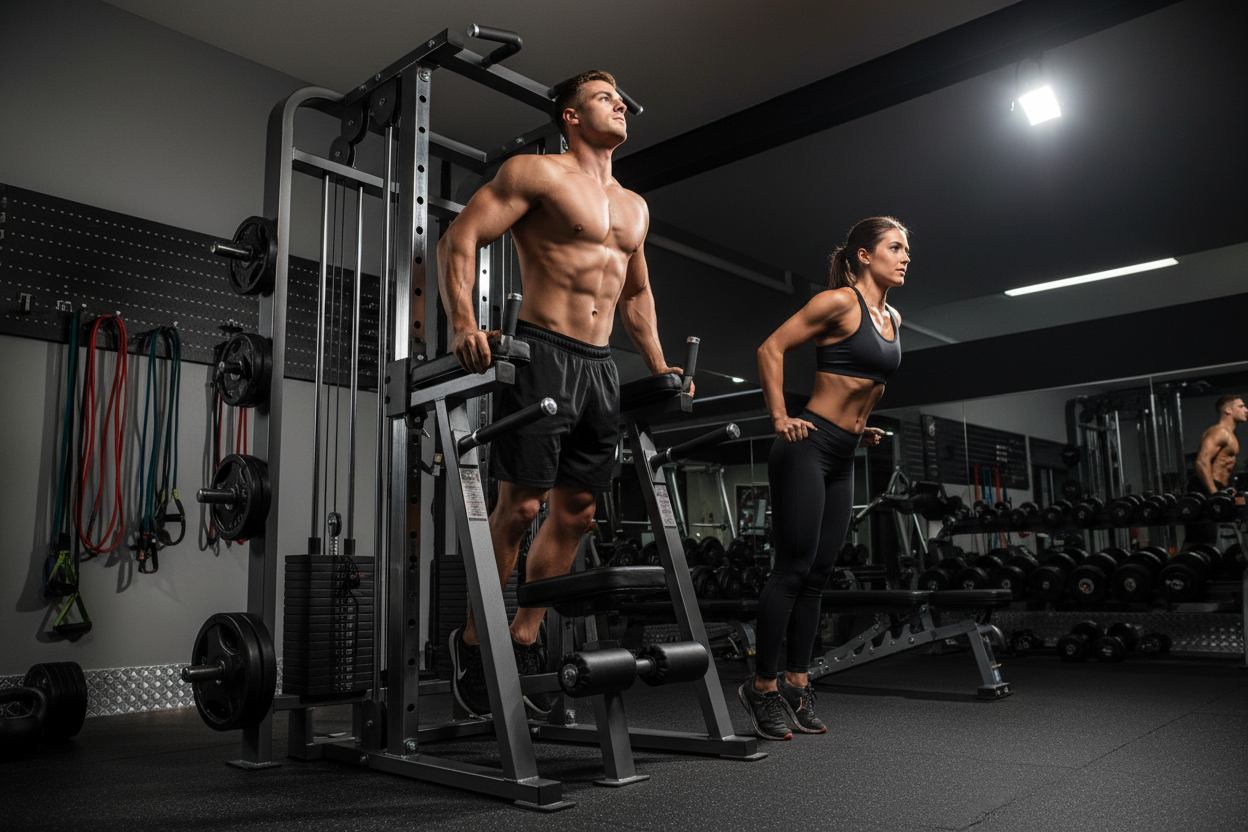
The beauty of this machine lies in biomechanical strictness. By resting your weight on the knee or foot platform, you eliminate the 'kipping' or swinging motion common in bodyweight pull-ups. This forces your latissimus dorsi and lower traps to do the heavy lifting, making it an incredible tool for hypertrophy and mind-muscle connection.
The Triceps Dip Advantage
Bodyweight dips can be notoriously tough on the shoulder joints, especially if you lack the strength to control the descent. The assistance platform allows you to control the eccentric (lowering) phase perfectly, keeping the tension strictly on the triceps and lower pectorals without risking shoulder impingement.
From Our Gym: Honest Take
We have had a commercial-grade unit in our main garage testing facility for over a year. The biggest standout? The linear bearings on the weight stack guide rods. Cheap models tend to catch or drag when you're using heavy assistance, but a high-quality machine glides silently. At 6'2", I found that I needed to carefully check the knee pad drop depth; on some budget models we tested, taller users will bottom out the weight stack before reaching full arm extension at the bottom of a pull-up. It is undeniably a bulky piece of gear, but for safely grinding out high-volume back and triceps work, it is unmatched.
Frequently Asked Questions
Is an assisted chin-up dip machine worth it for a home gym?
If you have the floor space and budget, absolutely. It is especially valuable if multiple people in your household train, as it safely accommodates both beginners learning their first pull-up and advanced lifters doing high-rep burnout sets.
Can I just use resistance bands instead?
While resistance bands are a great budget alternative, they provide uneven assistance—giving you the most help at the bottom of the movement and almost none at the top. A machine provides a smooth, linear counterbalance throughout the entire range of motion.
What is the typical weight limit?
Most high-quality machines boast a user weight capacity of 300 to 400 lbs, with the counterbalance weight stack usually maxing out around 200 to 250 lbs. Always check the manufacturer specifications before purchasing.